Best Epoxy Flooring for Florida's Humidity, Heat & Hurricanes: SWFL Climate Guide
Florida eats floors for breakfast.
Between 85% summer humidity, 95°F heat soaking concrete slabs, salt-laden air corroding everything within 10 miles of the coast, and the occasional Category 4 flooding the first floor — the flooring that works in Phoenix or Denver is the flooring that fails in Naples.
After installing epoxy floors across Southwest Florida and watching what survives decades versus what peels in 18 months, here's the honest climate-specific guide we wish existed when we started.
The 3 Climate Enemies of Every SWFL Floor
Enemy #1: Slab Moisture Vapor Emission (MVE)
This is the silent killer. Florida's high water table pushes moisture vapor up through your concrete slab 24/7. Most cheap epoxies can't handle more than 3 lbs/1000 sqft/24 hours of MVE. Naples residential slabs regularly test at 4–12 lbs.
Result if ignored: bubbles, osmotic blisters, white hazy "blushing," and full delamination within 1-3 years.
The fix: A moisture-mitigation primer (MVET-rated) before the color coat. Non-negotiable in SWFL. If a contractor quotes you a job without a calcium chloride test or vapor-barrier primer — walk away.
Enemy #2: UV Degradation
Standard epoxy (bisphenol-A based) will yellow and chalk under direct UV in about 6-18 months. On Florida pool decks, lanais, and near-window interior runs, this is a guaranteed problem with the wrong product.
The fix: Either
- Use a UV-stable aliphatic polyurethane or aliphatic polyaspartic topcoat over the epoxy, OR
- Use 100% UV-stable urethane-cement systems (what we use on commercial/pool deck)
Enemy #3: Thermal Shock
Naples slabs can go from 70°F AC-cooled garage to 120°F surface temperature in summer when the door opens. That 50°F swing flexes the concrete and whatever is bonded to it.
Result if ignored: hairline cracking, peeling at edges, and brittle-fracture failure.
The fix: Flexible-modulus epoxy formulations (ours include plasticizers rated for -20°F to 180°F service) + elastomeric expansion-joint fillers.
What Does NOT Work in SWFL
Let's save you money by listing what to avoid:
❌ Big-box DIY epoxy kits — No moisture primer. No UV package. Failure is a when not an if.
❌ Water-based "paint" epoxies — These are glorified porch paint. They'll bubble the first rainy season.
❌ Single-part "one and done" coatings — If it doesn't come in a Part A + Part B, it's not a real epoxy.
❌ Non-Florida contractors — We've seen national franchises use Phoenix specs in Naples and fail within a year.
❌ Solvent-based industrial floor enamel in residential — Wrong product for the application.
What DOES Work: Products We've Validated for SWFL
For Garages (Humid, Thermal Cycling)
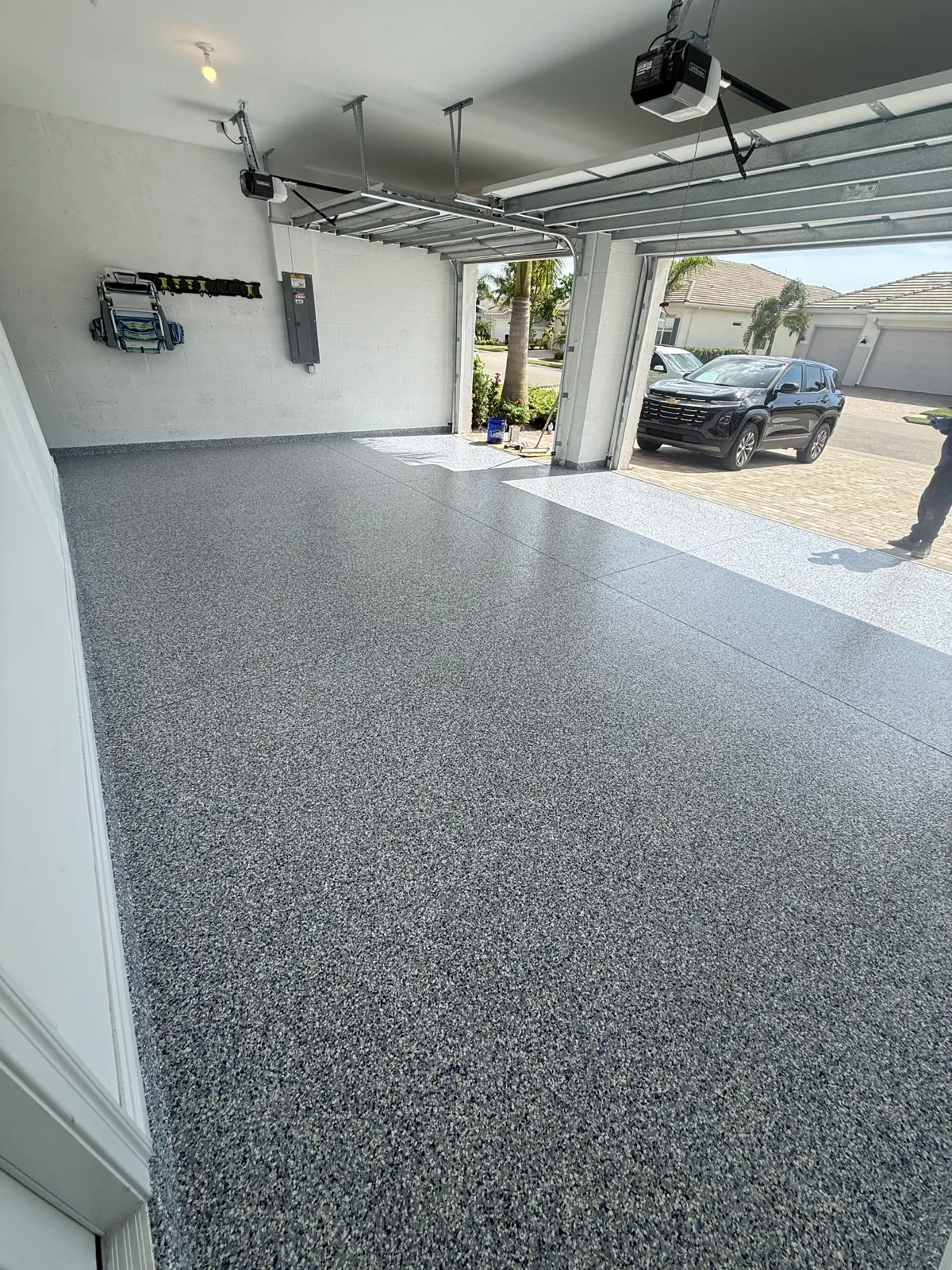
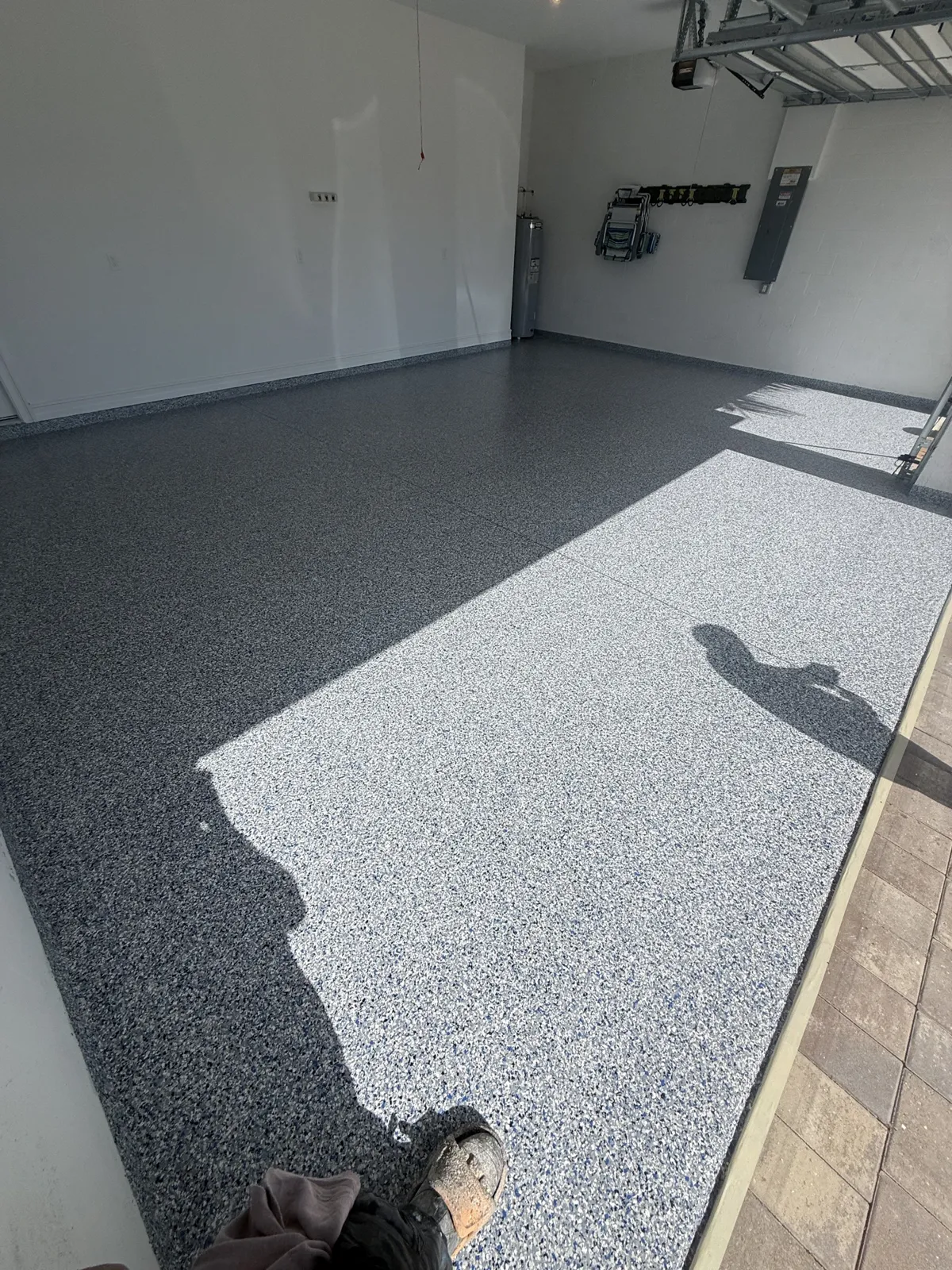
Winning system: High-solids epoxy base + broadcast colored flake + aliphatic polyaspartic topcoat.
Why: Flake provides texture and hides concrete flaws. Polyaspartic topcoat provides UV stability and chemical resistance. Moisture primer underneath handles slab MVE.
Expected lifespan in Naples: 15–25 years with a warranty.
For Pool Decks (UV + Salt Air + Wet + Bare Feet)
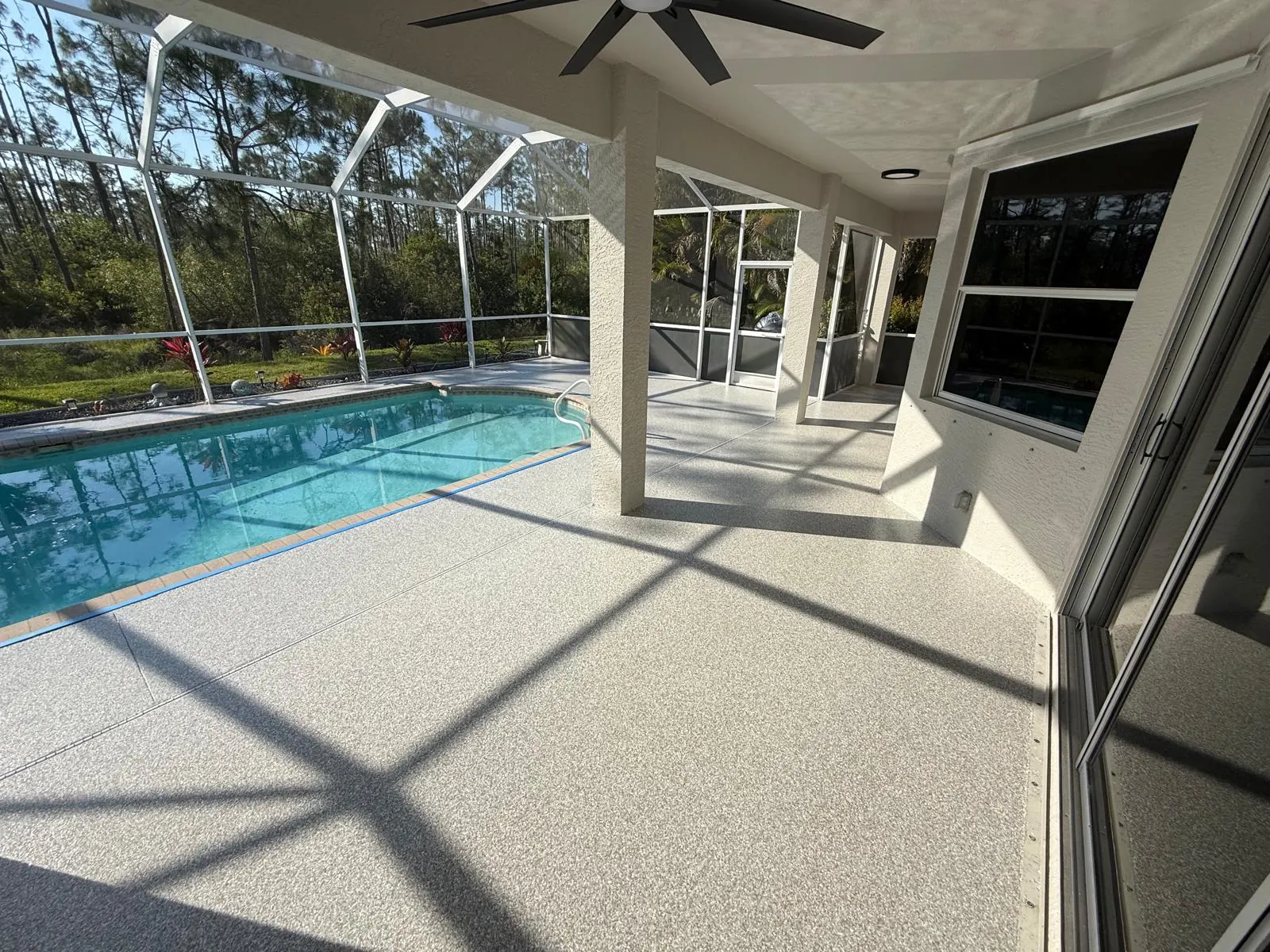
Winning system: Quartz-broadcast urethane-cement or 100% UV-stable aliphatic polyaspartic with slip-texture aggregate.
Why: Cooler than dark pavers, slip-safe when wet, chlorine/salt resistant, won't yellow.
Expected lifespan in Naples: 10-15 years (salt is brutal on everything, even stainless).
For Interior Metallic (Climate Controlled)
Winning system: 100% solids metallic epoxy + UV-stable clear topcoat.
Why: In a climate-controlled interior, UV is the only real threat (through windows). The UV topcoat handles it.
Expected lifespan in Naples: 20+ years.
For Commercial Kitchens (Thermal Shock + Chemical)
Winning system: Urethane-cement slurry system.
Why: Handles 300°F steam cleaning, acids, bleach, and impacts. USDA/FDA compliant.
Expected lifespan in Naples: 15-20 years.
For Hurricane-Prone Coastal Properties
Winning system: Waterproof urethane-cement base + epoxy color coat + polyaspartic topcoat.
Why: This multi-layer system can survive days of standing flood water and be re-used after cleaning.
Expected lifespan in Naples: 15+ years even with one major flood event.
Preparing Your Epoxy Floor for Hurricane Season
Every September we get calls from Naples homeowners who want to know: "Will my floor survive a hurricane flood?"
What Happens During a Flood
Water enters your garage/home. It sits for hours or days. It contains:
- Salt water (coastal)
- Mud, debris, sewage overflow
- Gasoline, oil, chemicals washed from streets
- Warm temperature (Florida floods aren't cold)
What a Properly-Installed Epoxy Floor Does
- The waterproof seal stays intact. Because epoxy is a continuous membrane, there are no grout lines or cracks for water to infiltrate underneath.
- No absorption. Epoxy doesn't soak up floodwater the way tile grout and concrete do.
- Bleach-and-pressure-wash cleanup. Most floodwater contamination comes off with aggressive cleaning.
- The floor structure survives. When prep is done right, a properly-installed floor comes back as good as new after cleanup.
What Fails in Floods
❌ Tile grout — absorbs contamination, mold grows, requires complete re-grout.
❌ Carpet — 100% loss, mandatory replacement.
❌ Vinyl plank — edges lift, adhesive fails, often full replacement.
❌ Cheap epoxy with bad prep — hydrostatic pressure from below lifts the coating.
Our Storm-Season Upgrade
We offer an enhanced moisture-protection package for clients in flood-prone areas that includes:
- Waterproof urethane-cement moisture base (rated for standing water)
- Sealed expansion joints with polyurea
- Epoxy-coated transition thresholds to adjoining rooms
The Florida Humidity Install Protocol
Installing epoxy in 85% humidity without the right protocol is how amateurs destroy jobs. Here's our SWFL process:
Pre-Install (Day -7)
- Moisture test — calcium chloride (ASTM F1869) and relative humidity probes (ASTM F2170) in the slab.
- Slab integrity — chain drag for hollow spots, crack mapping, profile grinding needed.
- Weather window check — we won't install during tropical system rainfall even indoors.
Install Day
- Climate control — temporary AC or dehumidification if garage isn't conditioned. Target: <70% RH at floor.
- Moisture vapor primer — vapor-barrier rated for the measured MVE load.
- Diamond-grind prep — concrete surface profile CSP-3 minimum (feels like 60-grit sandpaper).
- Hot-pot catalyzed batches — small batches mixed for <15 min pot life in FL heat.
Cure Window
- 72-hour climate-controlled cure — no humidity spikes allowed.
- Post-install thermal imaging — catches voids or uncured spots before they fail.
That's the difference between a floor that lasts 18 months and one that lasts 25 years.
SWFL-Specific Service Area Considerations
Naples Proper
Older slabs (pre-1990) often have no vapor barrier beneath. Always requires moisture primer. We've seen test readings up to 14 lbs MVE in older Naples Park homes.
Marco Island
Salt air penetration is extreme. We add corrosion inhibitors at thresholds and specify aliphatic urethane topcoats that resist chloride ion permeation.
Fort Myers & Cape Coral
Post-Ian flooding exposed many failing coatings. We're seeing heavy demand for moisture-resistant systems here.
Bonita Springs & Estero
Newer construction, cleaner slabs — sometimes installs are straightforward. Always test, never assume.
Inland (Ave Maria, Lehigh, Golden Gate)
Less salt air, but higher termite/moisture concerns. Vapor barrier is critical.
FAQ
Q: Can I install epoxy during rainy season?
A: Yes, indoors with climate control. We do it year-round in conditioned spaces. Outdoor pool decks wait for a 5-day dry window.
Q: What if I already have a failing big-box epoxy floor?
A: Usually repairable. We grind off the failed coating, re-prep, moisture-mitigate, and reinstall. About 30% of our quotes are "rescue jobs."
Q: Is there a Florida building code for epoxy flooring?
A: For commercial work: yes (FBC references ANSI/NSF standards). For residential: no mandatory code, but insurance providers increasingly want documentation of moisture mitigation for claim validity.
Q: Will my floor stick to a salt-contaminated slab near the beach?
A: Only if we grind off the salt-contaminated concrete surface and re-profile. It's doable, just adds a day of labor.
Ready for a Florida-Proof Floor?
If you're tired of tile popping, paint peeling, or a previous epoxy install failing — we'd love to show you what a properly-specified SWFL system looks like.
Book a free slab inspection: (239) 276-1462
Service area: Naples, Marco Island, Bonita Springs, Estero, Fort Myers, Cape Coral, and all of Collier & Lee County.
Published: January 2026 | Reading Time: 11 minutes