New Construction Garage Coatings in Lakewood Ranch: Why Builder Slabs Need Special Prep
Lakewood Ranch is one of the best-selling master-planned communities in the United States — 40+ villages, 19+ active builders, and thousands of new homes still to be delivered across Manatee and Sarasota County. Every one of those homes comes with the same thing: a gray, builder-grade concrete garage slab that stains the first time a car drips oil on it.
Coating that slab is one of the smartest first upgrades a new homeowner can make. But here is what most people — and plenty of coating installers — get wrong: a new construction slab is actually harder to coat correctly than a 20-year-old one.
This guide explains why, and what a proper installation looks like in Lakewood Ranch, Bradenton, and the surrounding corridor.
The hidden problem: curing compounds
When your builder poured the slab, the concrete crew almost certainly sprayed a curing compound on the fresh surface. It is standard practice — the membrane slows moisture evaporation so the slab cures stronger and with less cracking.
The problem: that same membrane is a bond breaker. It is designed to seal the surface, which means epoxy cannot penetrate and grip. Roll a coating straight over a cured membrane and you get a floor that looks great for a few months and then starts peeling in sheets — usually right where hot tires sit.
You cannot see a curing compound reliably. You cannot wash it off. Acid etching — the shortcut method sold with DIY kits — does not remove it either. There is only one correct answer:
Diamond grinding: the non-negotiable step
Every new-construction garage we coat gets mechanically ground with diamond tooling before anything else happens. Grinding does three jobs at once:
- Removes the curing compound and surface laitance (the weak, powdery top layer of cream on new concrete).
- Opens the pores so the epoxy penetrates and anchors mechanically.
- Creates the correct surface profile — CSP-2 to CSP-3 under ICRI standards, which is what coating manufacturers specify for warranty coverage.
Our grinders run with HEPA dust extraction, so the process is clean enough for a finished, occupied home. If a contractor quotes your new Lakewood Ranch home and the word "grinding" is not in the scope — or they mention acid etching instead — that is your cue to keep shopping. We cover this in detail in our surface preparation guide.
New slabs hold moisture — test before coating
Concrete takes roughly 28 days to reach design strength, but it keeps releasing moisture for months. Florida adds its own twist: slabs poured on grade over our high water table can see real vapor drive year-round.
Coat a slab that is still releasing too much moisture and vapor pressure will blister the coating from below. That is why we moisture-test every new slab before install day. If readings are elevated, we install a moisture-tolerant primer rated for the condition — a small line item that protects the entire system.
Practical rule for new Lakewood Ranch homes: the slab should be at least 30-60 days old before coating, and it must pass a moisture test regardless of age. Closing on your home and coating the garage the same week is usually fine time-wise — we just verify instead of guessing.
What system makes sense for a new build
For new-construction garages in the Bradenton-Sarasota corridor we install the same system we trust across Southwest Florida:
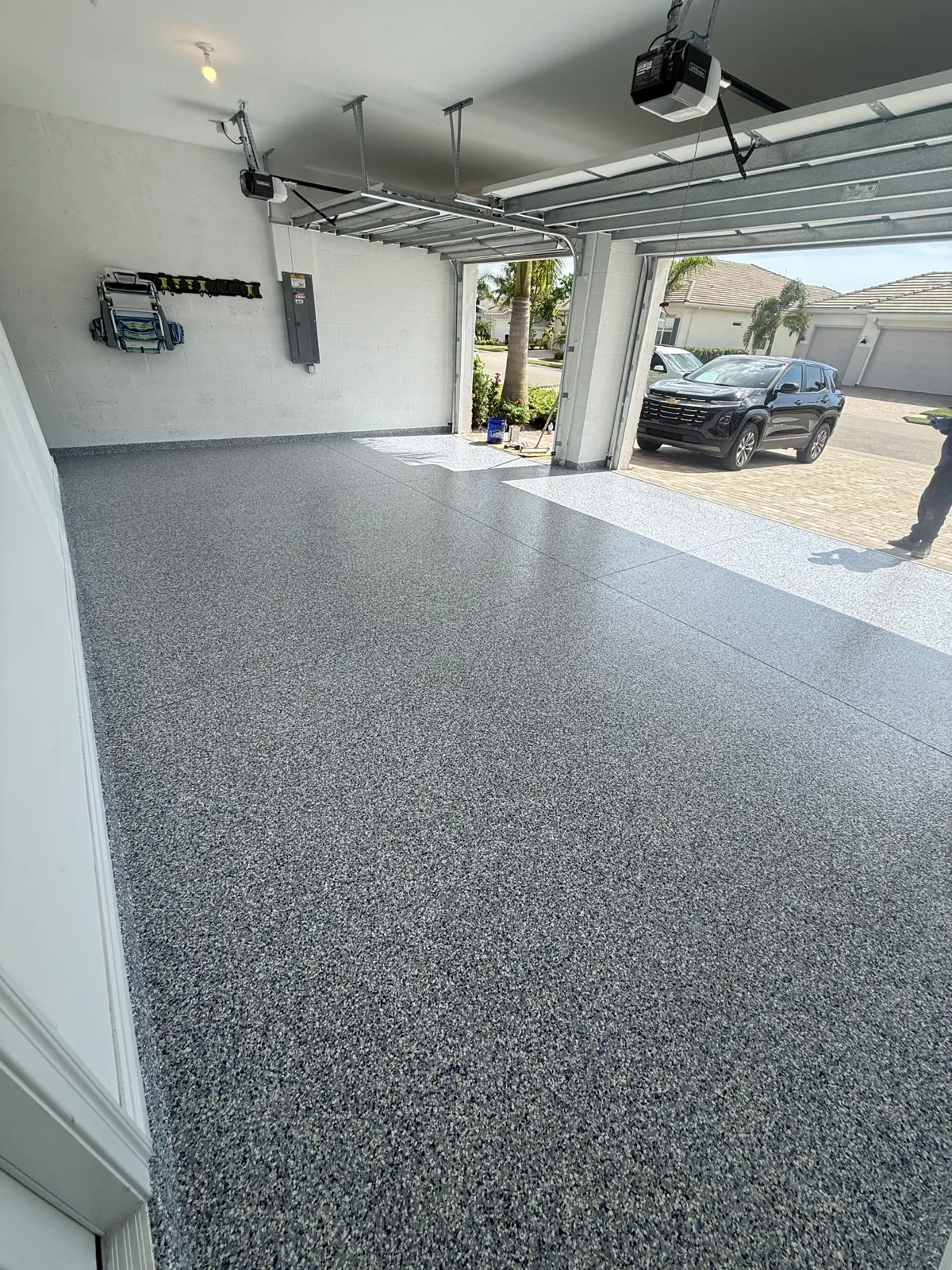
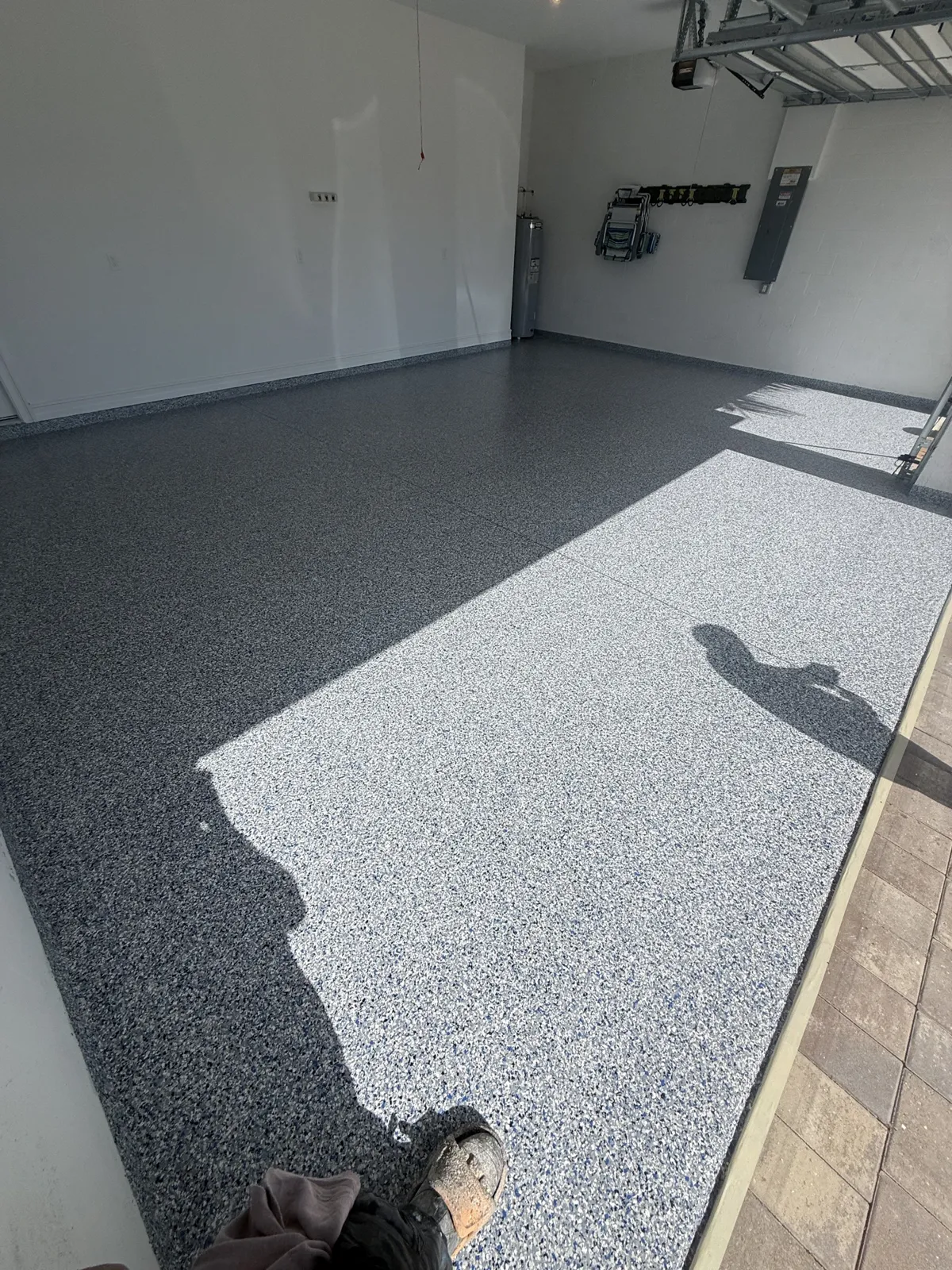
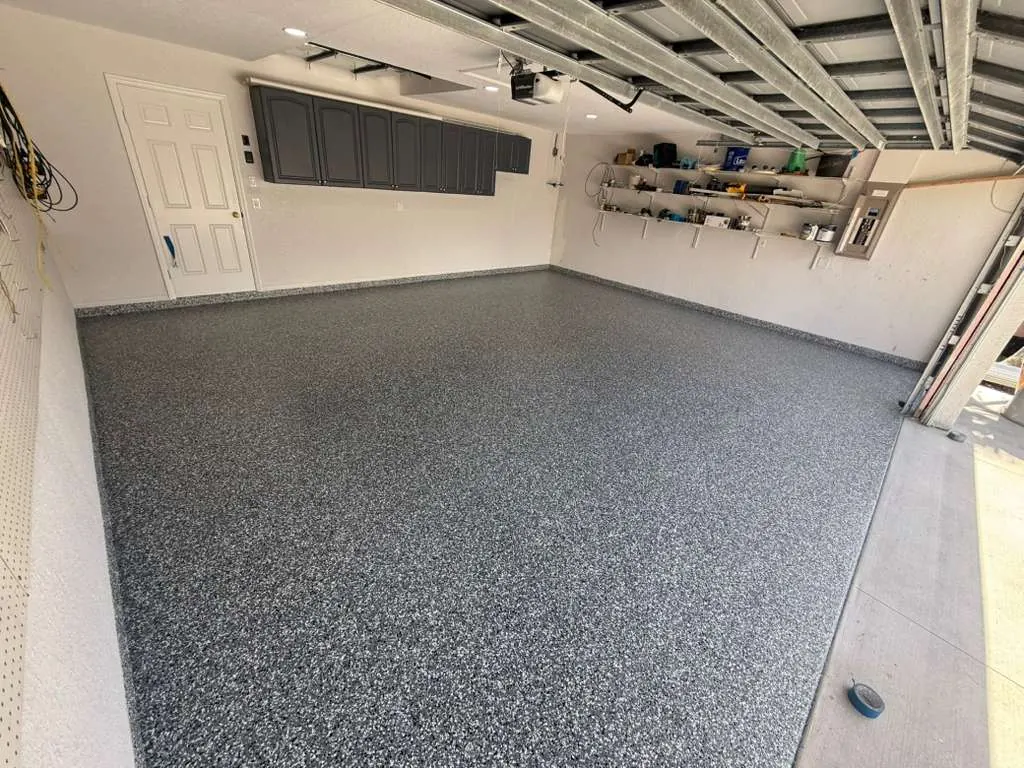
- Full-broadcast flake epoxy with a 100% solids epoxy base and a UV-stable polyaspartic topcoat. It hides future scuffs, adds slip resistance, shrugs off hot-tire pickup, and never needs waxing. Typical investment: $6-10 per square foot — roughly $2,700-$4,500 for a standard 2-car garage.
- Metallic epoxy for owners who want a showpiece floor in a luxury build: $8-15 per square foot.
Both carry our lifetime residential installation warranty — possible only because the prep protocol above is done on every job. You can read exactly what the warranty covers on our warranty page.
HOA and builder considerations
Most Lakewood Ranch villages have architectural standards, but garage interiors are almost never restricted — the coating happens inside your home. If your community requires documentation, we provide insurance certificates and product data sheets for approval without drama.
Building or buying with one of the area builders? We install for individual homeowners after closing, and we also work directly with builders and general contractors on garage packages, model homes, and full phases — scheduling around punch lists and CO dates. Builders can invite us to bid here.
Common questions from Lakewood Ranch homeowners
How soon after closing can I coat my garage? As soon as the slab passes a moisture test — usually any time after the slab is 30-60 days old. Most closings happen well past that window.
My builder offered a coating upgrade. Should I take it? Ask one question: "Is the slab diamond-ground, and is the topcoat polyaspartic?" Builder-package coatings are often thin, single-coat paint systems applied fast, straight over the curing compound. If they cannot confirm mechanical prep, decline and have it done right after closing.
Does the Florida heat affect installation? We schedule around slab temperature and humidity. Polyaspartic topcoats actually cure beautifully in Florida conditions when the prep underneath is correct.
Do you really service Lakewood Ranch? Yes — we install across the Bradenton-Sarasota corridor, including Waterside, Country Club East, Esplanade, Del Webb, Parrish, and Palmetto. See our Lakewood Ranch and Bradenton service page or compare options on our garage floor coating page.
The bottom line
A new Lakewood Ranch home deserves better than a DIY kit rolled over a curing compound. The difference between a floor that lasts 2 years and one that lasts a lifetime is not the coating in the bucket — it is the grinder, the moisture test, and the installer who refuses to skip them.
Get a free quote for your new construction garage — send us photos and your community name through our quote form, or call (239) 276-1462. We will tell you honestly whether your slab is ready.