Polished Concrete for Schools, Offices & Retail in Sarasota–Manatee: Cost, Process & Real Results
Walk a new school, a Class A office lobby, or a well-designed retail space in Sarasota or Manatee County and look down. Increasingly, the floor is not tile, not carpet, not VCT — it is the building's own concrete slab, mechanically ground and polished to a controlled sheen. Polished concrete has moved from industrial novelty to institutional default, and the reasons are almost entirely economic.
We have polished floors at every scale in this market — including a 73,000 square foot school project (full case study here) — and this guide shares what facility managers, GCs, and owners should know before writing it into a spec.
What polishing actually is
Polished concrete is not a coating. It is a mechanical transformation of the slab surface:
- Coarse metal-bond diamond grinding — removes laitance, old glue, coatings, and imperfections, exposing sound concrete
- Densifier application — a lithium silicate penetrant that reacts with the concrete to harden the surface chemically
- Progressive resin-bond polishing — successive grits (like sanding wood) up to the target gloss level
- Stain guard — a penetrating protector that buys reaction time against spills
Because the finish IS the slab, there is nothing to peel, chip, or delaminate — the failure modes that end coating and tile floors simply do not exist.
Why institutions keep choosing it
The lifecycle math is brutal — in polishing's favor. VCT looks cheap on day one, then demands stripping and waxing several times a year, forever. Over a decade, a school district pays for its VCT floor multiple times in labor and chemicals. Polished concrete needs a dust mop, an auto-scrubber with neutral cleaner, and a re-burnish every few years. That maintenance delta is why school districts and facility managers drive this specification.
It survives institutional traffic. Rolling book carts, scissor lifts, food service lines, 2,000 students a day — a densified slab shrugs it off.
Light and air quality. Higher gloss levels measurably bounce ambient light (brighter corridors, lower lighting loads), and there is no wax off-gassing or flooring adhesive in the indoor-air equation.
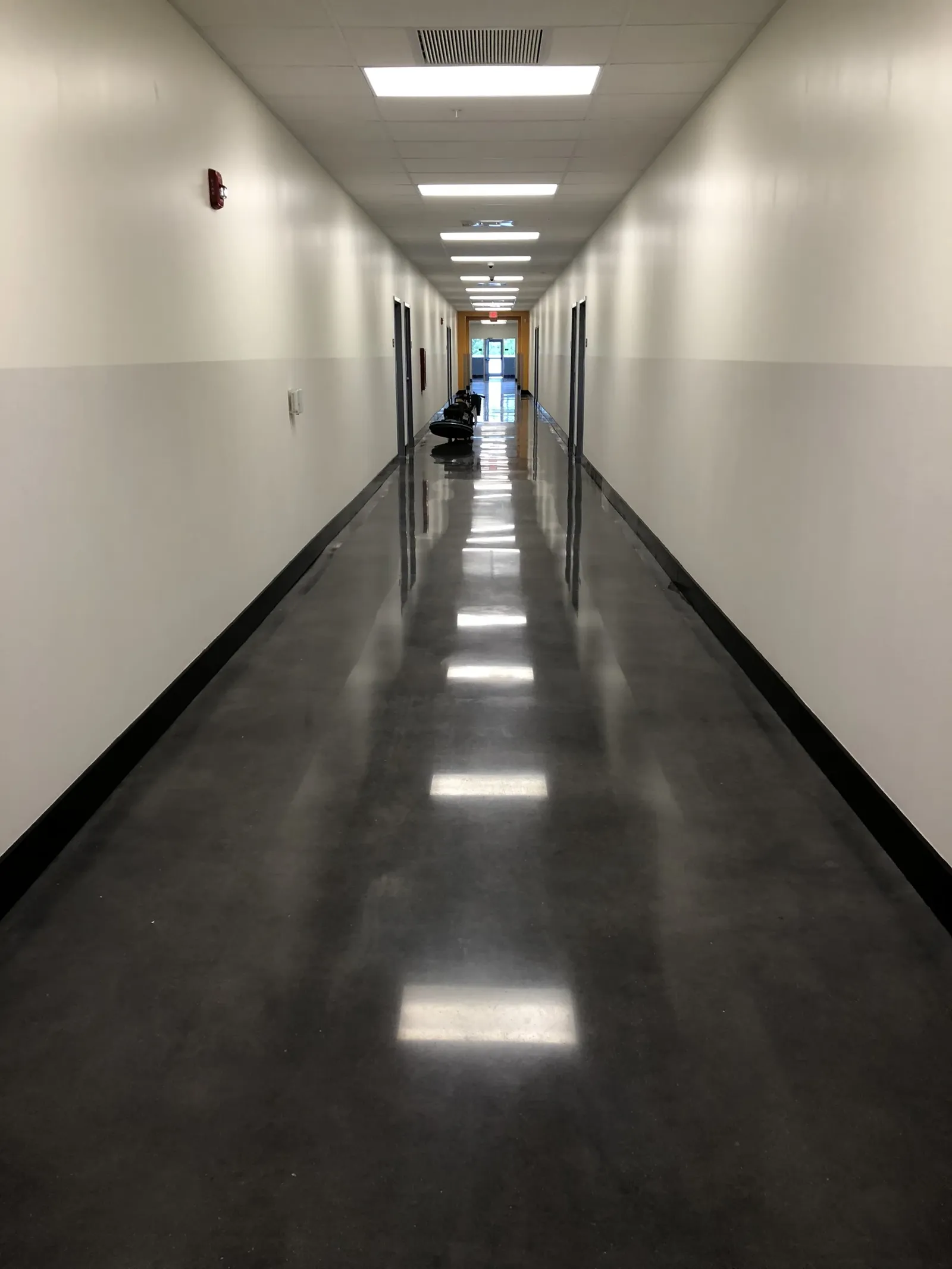
It reads as design. Exposed aggregate or a clean cream finish in charcoal or natural gray fits the architecture Sarasota builds — see the charcoal corridors in our school project photos.
Gloss levels and aggregate exposure
Specify polished concrete with two choices:
- Sheen: Level 1 (flat/matte) → Level 4 (mirror gloss). Schools typically take Level 2–3; showrooms and lobbies go Level 3–4.
- Aggregate exposure: cream (no stone visible), salt-and-pepper (fine sand exposure — the institutional standard), or full aggregate (terrazzo-like).
Integral dyes — charcoal being the corridor favorite — go in during polishing for color that cannot wear off.
What it costs in the Sarasota–Manatee market
Polished concrete runs $5–12 per square foot depending on gloss level, aggregate exposure, dye work, slab condition, and — critically — square footage. Large open floor plates (schools, warehouses, retail shells) hit the bottom of the range because planetary grinders run efficiently at scale; small cut-up spaces with edge work trend higher.
For comparison: it is routinely the lowest 10-year cost floor an institutional building can own, even when its day-one price matches or slightly exceeds VCT.
Lessons from 73,000 square feet
Our school project taught (or re-taught) every lesson that matters at institutional scale:
- Schedule is everything. We phased grinding, densifying, and polishing across wings so other trades never stopped. Polishing is dust-controlled (HEPA-extracted) and low-odor, which is why it can run alongside finish trades.
- Slab condition drives the spec. Patches, trenches, and pour joints do not disappear — they get honest treatment (repair mortar, joint fill) and the finish level is chosen to work with the slab, not against it.
- Burnished consistency needs a single crew standard. Gloss uniformity across 73,000 sq ft only happens when grit progression and densifier timing are identical wing to wing.
GCs bidding school, municipal, or commercial work in Manatee and Sarasota County: we carry SAM.gov registration (UEI on file), OSHA 30 supervision, and references at scale — invite us to bid or grab our capability statement on the government contracts page.
Where polishing is the wrong answer
Honesty builds specs that last: polishing is wrong for cookline kitchens (thermal shock — that is urethane cement territory), constantly wet rooms needing slip texture and cove base (quartz epoxy wins there), and badly contaminated or patched slabs where a decorative look matters more than the slab can give — those get an overlay or coating instead. We install all of these systems, so our recommendation follows your building, not our truck.
Frequently asked questions
Is polished concrete slippery? Wet-tested properly, a Level 2–3 polish meets standard slip coefficients — comparable to or better than waxed VCT. High-gloss levels in wet entries get walk-off matting, same as any hard floor.
Can you polish our existing 30-year-old slab? Usually yes — old slabs often polish beautifully. Glue and coating removal is part of our standard scope; see our coating removal service.
How fast can occupied spaces be done? Nights and weekends, in phases, with sections returned to service each morning. No cure time to wait on and no odor complaints — the advantage of a mechanical finish.
What maintenance does it really need? Dust mop, neutral-cleaner auto-scrub, periodic burnish. No wax. Ever. The savings are the point.
Price a polishing project in Sarasota–Manatee
From a 2,000 sq ft showroom in downtown Bradenton to a full school campus, we will walk your slab and give you straight numbers by finish level. Start at our concrete polishing page, see the Bradenton commercial hub, or request a walkthrough.