Salt Damage, Chlorine & Your Pool Deck: Protecting SWFL Outdoor Surfaces
If you live within 10 miles of the Gulf — which in Naples, Marco Island, Bonita Springs, or coastal Fort Myers is basically everyone — you're fighting an invisible war against chloride ion corrosion.
And if you own a pool, you're hosting a second battlefield: free chlorine attacking your deck from the splash zone 365 days a year.
Most homeowners don't see the damage until it's catastrophic: spalling concrete, rusted rebar, bubbling paint, and unsafe pool decks that need tens of thousands of dollars in repair.
This guide explains what's actually happening, how to test for it, and the coating system we specify on SWFL coastal pool decks — engineered specifically to survive what Florida throws at it.
The Chemistry (Quick, Then We Move On)
Salt Air Attack
Gulf breeze carries chloride ions (Cl⁻) in micro-droplets. They land on your concrete. They penetrate porous surfaces. They reach embedded rebar. They catalyze oxidation (rust). Rust expands 6-10× in volume. This is how concrete spalls.
Naples is classified as C5-M (Marine High) corrosion zone by the ISO 12944 standard. For reference, that's the same category as coastal industrial refineries. Your pool deck is under more chemical stress than most factory floors.
Chlorine Attack
Your pool's free chlorine (hypochlorous acid, HOCl) splashes and evaporates on your deck. The evaporation concentrates chlorine and forms:
- Calcium hypochlorite deposits (that white crust)
- Bleach-strength surface attack on unprotected surfaces
- Breakdown of pigments, sealers, and resins over time
Combined Damage
Salt + chlorine + Florida UV + thermal cycling = the perfect storm for outdoor surfaces. Few materials survive all four.
What We See Failing on SWFL Pool Decks
1. Plain Broom-Finish Concrete
- Spalls within 10-15 years
- White efflorescence within 2-3 years
- Hot to bare feet
- No slip resistance when wet
- Verdict: Not fit for coastal pool deck purpose
2. Concrete Pavers
- Individual paver staining and pitting
- Settling and lipping (trip hazards)
- Grout/sand joints erode — constant re-sanding
- Verdict: High maintenance, moderate life
3. Kool-Deck / Cool Deck Paint
- Fails at 5-8 years in SWFL salt environment
- Peels, chips, and dust away
- Absorbs chlorine — permanent staining
- Verdict: Cheap now, expensive later
4. Quarry Tile / Ceramic
- Grout disintegrates within 5-7 years
- Salt crystallization pops tiles off
- Expensive to repair
- Verdict: Works until it doesn't
5. Stamped Concrete Overlays
- Pattern wears in traffic zones
- Sealer fails in 3-5 years
- Color fades under UV
- Verdict: Moderate at best
What Actually Works: The Coastal-Rated System
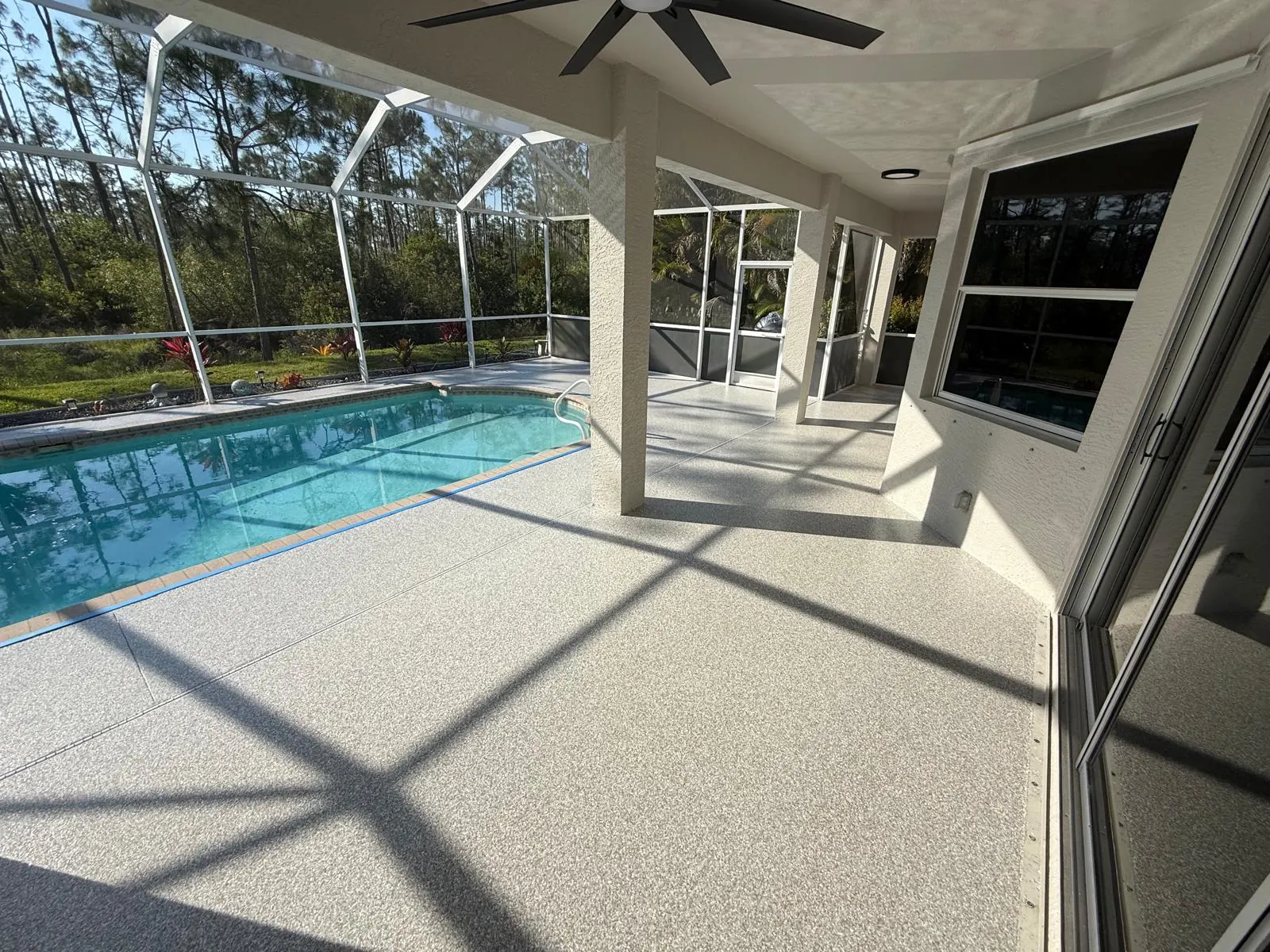
The 4-Layer Pool Deck System We Install in SWFL
Layer 1: Moisture-Mitigation Primer
Seals the concrete from rising groundwater and existing salt contamination. This is skipped by 90% of competitors. It's non-negotiable in salt environments.
Layer 2: Chloride-Resistant Epoxy Base
A 100%-solids epoxy formulated with chloride-ion blocking chemistry. Bonds to the slab, prevents salt migration from below, and provides the color base.
Layer 3: Quartz or Silica Aggregate Broadcast
Broadcast-to-excess silica quartz provides:
- Slip resistance when wet (SCOF >0.60 wet per ANSI A137.1)
- Cooler surface temperature (textured surface holds 8-15°F lower than smooth)
- Aesthetic depth (granite-like appearance)
- Mechanical wear protection
Layer 4: Aliphatic Polyaspartic or Polyurethane Topcoat
This is the hero layer. Aliphatic polyaspartics are:
- UV stable — won't yellow or chalk
- Chlorine resistant — tested to 1,000+ hours of 10% sodium hypochlorite exposure with no degradation
- Salt-spray resistant — passes ASTM B117 at 2,000+ hours
- Fast curing — ready for foot traffic in 4-6 hours, full service in 24
Total system thickness: 35-60 mils (that's 8-12× the thickness of typical "pool paint").
Total cost installed in Naples: $9-15/sqft depending on size and condition.
Expected life: 10-15 years before refresh; 20+ with one mid-life topcoat refresh.
Testing YOUR Deck: Is It Damaged Already?
Before we quote, we test the existing slab for:
1. Surface Chloride Test
We take 3-5 deck samples with a cold drill and send to lab for chloride concentration. Results:
- <0.025% by weight: Safe to coat with standard system
- 0.025-0.10%: Requires chloride-scavenger primer (extra $1-2/sqft)
- >0.10%: Contamination is severe; we recommend removing the top 1/4" of concrete before coating
2. Moisture Emission Test
ASTM F1869 calcium chloride. Coastal slabs often read 6-12 lbs — requires stronger moisture primer.
3. Visual Spall & Crack Map
We mark every spall, crack, expansion joint, and stain. Repairs use hybrid polyurea-epoxy mortar that bonds to salt-damaged concrete.
4. Deflection & Settlement Check
We drag a chain to find hollow/delaminated zones. Sometimes the deck needs structural injection before any coating can be applied.
5. Existing Coating Adhesion Test
If there's an old coating, we do a cross-hatch knife test. Failure = removal required.
Example Scenario: A Typical Marco Island Pool Deck Rescue
Situation: 1,800 sqft pool deck, 20 years old, last coated in 2016 with generic acrylic deck paint. Visibly peeling, rusted rebar staining bleeding through, multiple spalls, guest trip hazard.
Our process:
- Full removal of failing acrylic coating (diamond grinding, 1 day)
- Spall repair with salt-tolerant epoxy mortar (2 days)
- Rebar passivation treatment on 3 exposed spots (1 day)
- Chloride-scavenger + moisture primer (1 day)
- Chloride-resistant epoxy base coat with broadcast quartz (1 day)
- Aliphatic polyurethane topcoat (1 day)
Total install: 6 days
Cost: $22,500 (at $12.50/sqft)
Written warranty: 10 years against delamination and chemical attack
Result: A seamless, salt-resistant deck engineered to withstand storm-surge submersion — and noticeably cooler barefoot than the old dark acrylic surface.
Maintenance: What You Actually Have to Do
We hear this from clients a year in: "I don't have to do anything?"
Pretty much. Here's the maintenance schedule:
Weekly (During Pool Season)
- Rinse deck with fresh water to remove pool splash + dust. 5 minutes.
Monthly
- Soft-brush with pH-neutral cleaner. 20 minutes for 1,500 sqft deck.
Annual
- Visual inspection for expansion joint wear
- Re-caulk expansion joints if needed ($0-200)
Every 7-10 Years
- Topcoat refresh pour (no need to re-do the whole system). $2-4/sqft.
Compare this to Kool-Deck (repaint every 4 years at $4-6/sqft) or pavers (re-sand every 2 years, replace cracked pavers constantly).
FAQ
Q: Can you coat over an existing Kool-Deck / cool deck surface?
A: Only if it's well-adhered and sound. Most need removal first. We'll do an adhesion test during the site visit.
Q: Will it be too hot for bare feet?
A: With the right light color + textured aggregate finish, our decks run 8-15°F cooler than dark pavers. White quartz broadcasts are especially cool. We can show you IR thermometer readings of existing installs on request.
Q: What happens if the pool pump backflows bleach onto the deck?
A: Nothing. Our topcoat resists 10% sodium hypochlorite (stronger than pool chlorine) for 1,000+ hours in accelerated testing.
Q: Can this go around spa equipment, skimmers, handrails?
A: Yes. We mask and pour around existing fixtures, or temporarily remove them if the install requires it.
Q: What about tile coping / paver border transitions?
A: We can blend to most existing coping types. Sometimes a transition strip is installed. We discuss this during the site visit.
Q: How does it handle storm season?
A: Our exterior systems are seamless and non-porous — they shed standing water and typically only need a rinse after heavy rain.
Q: What about stamp patterns?
A: We can integrate decorative elements (borders, inlays, logos). It adds cost but is possible.
Book Your Pool Deck Inspection
Free on-site inspection for Naples, Marco Island, Bonita Springs, Estero, Fort Myers, and Cape Coral homeowners. You'll get:
- Chloride + moisture test results (shared with you)
- Written spall & crack map
- System recommendation + fixed quote
- 10-year written warranty on install
Call: (239) 276-1462
Email: luis@epoxyart33.com
Serving all of SWFL coastal communities.
Published: December 2025 | Reading Time: 8 minutes